
Doctoral Research Programs
CLIMATE CHANGE AND ENERGY

DRP-CCE

Participation to IDSS workshop, February 17-21, 2020, University of Cape Coast, Ghana, Aissatou Ndiaye

The University of Cape Coast hosted an international training workshop on the Integrated Decision Support System (IDSS) from February 17-21, 2020 in Cape Coast, Ghana. The training was conducted by a team of practicing scientists from Texas A&M University. Participants in the training were graduate students and young scientists with backgrounds in economics, agronomy, water resources, hydrology energy, and engineering. Trainees were introduced to three models that make up the IDSS.
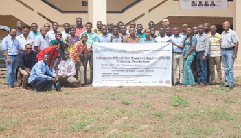
The training workshop started on Monday, 17th February 2020 at the department of Geography, University of Cape Coast at 8 am with the registration of the participants and followed with an opening remarks and welcome address respectively by Dr Benjamin Koffi Nyarko and the head of department of Geography. We had an ice breaker and group photo at 10:30 where participants introduced themselves and right after an introduction to the IDSS were given by the University of Texas team which were made of three people. Each of them gave a clear introduction to the model in which he is expert on. The IDSS is made of three models: SWAT, APEX and FARMSIM.
The afternoon session was a group discussion after a case study presentation of an IDSS by the team. We formed three groups according to our interests and were trained separately. Note that the training on the three models was done in parallel from the afternoon of the 1st day to end of the 4th day.
18th February 2020
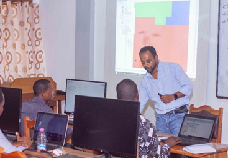
This was an individual workshop on SWAT in which I was interested in. The APEX and FARMSIM groups were in their different classrooms. We started at 8:30 am. The person in charge of the SWAT training was Dr Yihun Dile, Department of Ecosystem Science and Management, Texas A&M University. Some pen drives were shared containing SWAT materials like software set up, tutorials, data etc. After a long presentation on the SWAT model and how it works with some examples given on global applications and an interaction between trainer and trainees that took the whole morning, we installed the software and the class ended at 5 pm and an assignment was given on how to import data in the software.
19rd February 2020
On this day, we started at 9am because of some participants who came late and we were introduced QSWAT (QGIS SWAT). WE installed QGIS and were taught how the two-software work together. We had a long day handling the QSWAT. The content was after installation: structure and location of source data, structure and location of output data, setup for Robit Watershed, output visualization, SWAT error checker, preparing climate data, preparing land use and soil look up tables, adding tables into SWAT reference database, preparing global DEM data, using a predefined watershed and stream network, installing and using MPI, etc. the class ended at 5pm.
20th February 2020
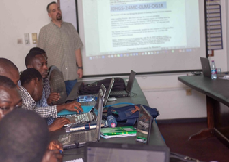
The objective of the trainer this day was to teach us inputting management data, calibration, scenario analysis and some other things like climate change, land use change etc. He started with a presentation on calibration techniques, calibration-validation-verification, model configuration, calibration/validation procedures, calibration time step, calibration/validation statistics. The presentation was followed by a practice with the QSWAT. The calibration is not a very simple task but the trainer was very dynamic turning around the class helping students having issues with the software, he always makes sure all students was at the same level and all the students understood what he was doing. The session was very interactive with a lot of questions.
21st February 2020
This day was the end of the main training. All participants were together, no more individual workshop. We had a restitution and an exchange of knowledge between participants, data sharing, networking, etc…Some presentations were done on the same IDSS tools by the trainers, exchange of question and discussion and the workshop ended at 4pm.
Useful Links
Contact Us
For information, additional information on the program:
Tel.: +227 20 31 50 14 / 96 89 79 81
E-mail : drp-cce@wascal-ne.org
B.P: 10662 FAST Niamey